

Join a community of more than 170,000 foreign students
Study in a Spanish University
Our pathway programs are made to help you join university in Spain. These programs train you in the Spanish language and other different subjects depending on which degree you want to do in Spain.
We help you, as International students, develop your fluency in Spanish both in speaking and writing while increasing their entry marks to apply to Public and Private Universities in Spain.
Study in a Spanish University
Your way to a Bachelor / Master program in a Spanish university
Ready to apply for a University in Spain?
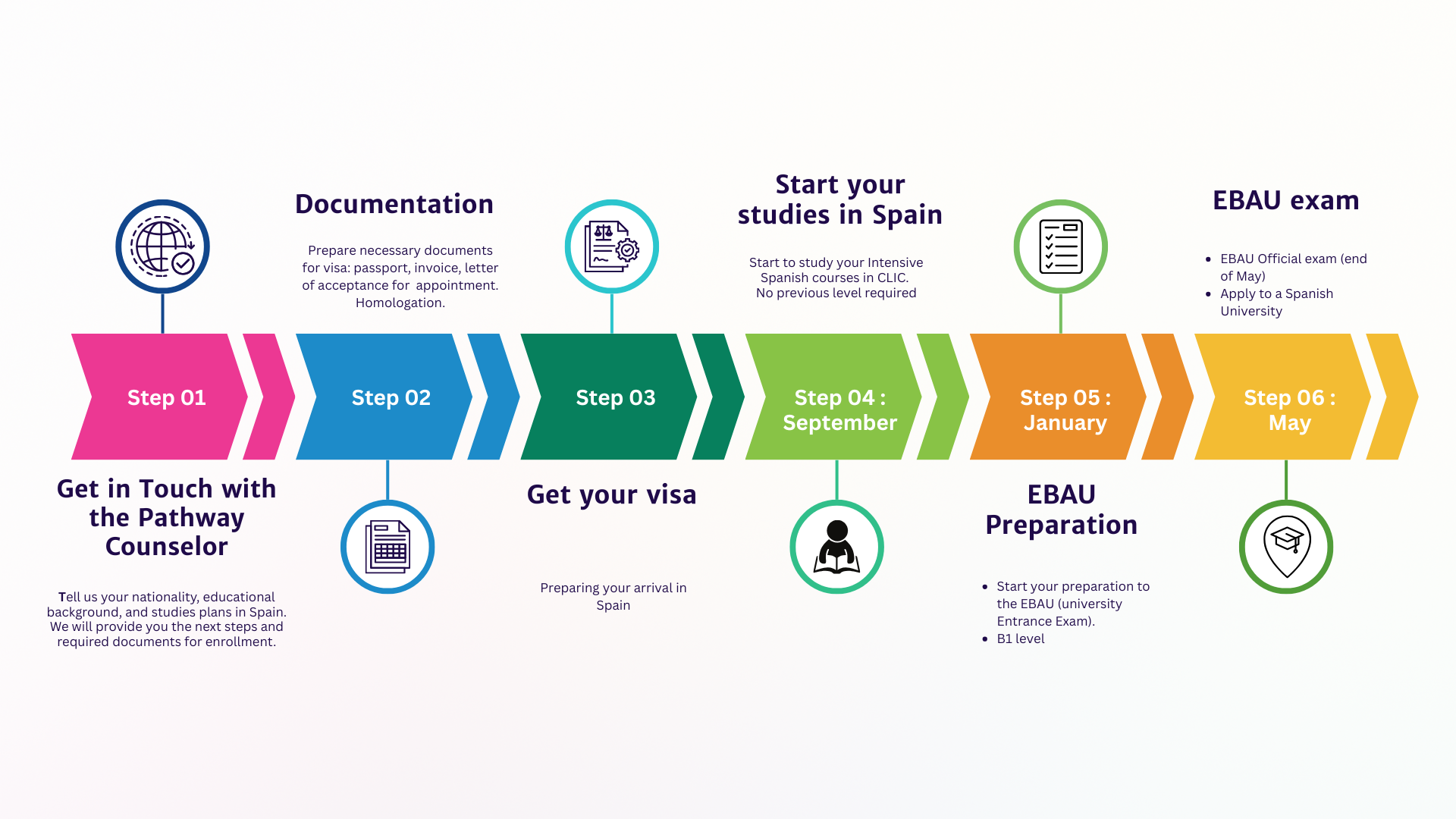
Here are your next Six steps!
Everything you need for the visa
Visa Information for studying in Spain
If you’re planning to study in Spain, the visa requirements depend on your nationality. Here’s what you need to know before applying.
Students from the EU/EEA
If you’re a citizen of the European Union or European Economic Area, you don’t need a visa to study in Spain.
Non-EU/EEA students
Most international students need a student visa to study in Spain. This applies to countries outside the EU, including the UK, Canada, and Australia.
Can U.S. citizens study in Spain without a visa?
Yes, U.S. citizens can study in Spain for up to 90 days without a visa. If your course lasts longer, you’ll need to apply for a student visa.
Can I work in Spain with a student visa?
Yes, student visa holders are allowed to work up to 30 hours per week while studying in Spain.
When Should I Decide on University or Vocational Training?
You don’t need to choose a university straight away when enrolling in our Pathway Program. Once you start, you can explore different universities, degrees and vocational training options in Spain. By November-December, you’ll need to have an idea of your preferences. Our academic advisors will help you decide based on your goals, grades, budget, and city preferences.
How Much Does University Cost in Spain?
Spain has 50 public universities and 39 private ones across the country. Public universities are more affordable, averaging around €2000 per year, compared to about €6000 per year for private universities. Choosing universities outside major cities like Madrid or Barcelona can simplify the process and reduce living costs.
What Spanish Level is Required for Universities in Spain?
While some Spanish universities offer courses in English, particularly in fields like Finance, Management, and Marketing, international students are generally expected to have a B1 or B2 level of Spanish for undergraduate programs. The requirements can vary by program and institution.
However, it is important to add that proficiency in Spanish is crucial for your EBAU preparation and is particularly important if you are interested in fields such as Human Sciences.
For students who may need an official certificate of Spanish proficiency for their university application we provide SIELE and DELE exams.
What is the Structure of the Pathway Program?
The Pathway program kicks off in September with an intensive Spanish course designed to accelerate students’ language skills with 20 classes per week. This preparation aims to ensure they meet the language requirements for both the EBAU exams and university entry. By November-December, students are encouraged to finalize their university preferences. During this period, our team provides personalized support to help students select their subjects, and the schedule for these subjects is carefully organized in collaboration with our reputable EBAU academy.
In January, students begin their EBAU preparation at the academy. Known for its effective teaching methodologies, the academy focuses on thorough exam readiness. The EBAU exams are held at the end of May, giving students ample time to research and deliberate on their university and degree choices throughout the Patwhay course. University applications typically open in June and close in early July.
How can CLIC help me with the student visa?
Once you’ve enrolled and paid in full, we will send you a Letter of Acceptance with your personal details to include in your visa application.
Where can I find official visa information?
Here are some trusted resources to help with your application:
Check the website of the Spanish Embassy or Consulate in your country for the most up-to-date requirements.
Do Non-EU Students Get Visa Support to Study at CLIC?
Yes! For non-EU/EEA students, we offer support in the application of a student visa to make it possible for you to come and study with us. Our Pathway Counselors will provide you with all the necessary information and assistance, and will help with important documents that will aid you in your student visa application.
For those needing conditional pre-admission from a university, we offer assistance through our partnerships with various universities and vocational schools.
How Can EU and non-EU Students Access University?
The requirements to access Spanish universities for international students varies by country of origin, as well as the Spanish region, the university, and degree of interest. Non-EU students must undergo a homologation process to ensure their foreign qualifications are recognized as equivalent to the Spanish Bachillerato. Depending on their desired program and the university’s requirements, these students may also need to take the EBAU or another entrance examination set by the university.
EU students can enroll in a Spanish university with their national high school diploma (such as the Abitur in Germany, Baccalauréat in France, or Esame di maturità in Italy) once it is officially translated. In these cases, you will not need to take the EBAU examination unless you are applying for specific degree programs that require higher marks, such as Medicine.
When, Where and How Do I Prepare for my EBAU Exams?
The EBAU preparation course is a crucial part of your Pathway journey. Depending on your nationality, previous academic performance, and chosen degree program at a Spanish university, you may need to study up to six subjects. When the time comes to begin your EBAU preparation, you’ll have achieved at least a B1 level in Spanish, which is necessary as the subjects are conducted in Spanish. You will be studying approximately 15 hours of classes per week. To ensure your success, we collaborate with a specialized EBAU preparation academy that has a proven track record with both Spanish and international students.
How Can I Improve my EBAU Exam Scores?
Certain degrees like Medicine, Architecture, or Business require foreign students to prepare for at least two additional exams to enhance their overall score. Spanish universities establish a “nota de corte,” which mandates that candidates achieve a minimum score to qualify for their chosen major or degree program. Some programs may require candidates to achieve a score of 7 or higher. To meet this criterion, students must prepare for two additional subjects tailored to their field of study. For example, students aiming to pursue Medicine may need to pass exams in Science and Mathematics to boost their average score. These additional exams can potentially increase their score by up to 4 points.
Fees of the Pathway Program
- Fee includes: Visa assistance & support with NIE application / Homologation of high school diploma/ Intensive Spanish course / Social and Cultural immersion program / PCE or EBAU exam preparation course for public University or Interview selection for private University
- Not included: Accommodation (but can be added to your booking) / Official translation of related documents / Exam fees / Academic transfer procedures
No scholarhips: CLIC does not offer scholarships. However, we can support students who receive scholarships elsewhere by providing necessary documentation, for example, proof of enrollment. - Not included:
– BASIC counselling: 200€ (includes: assistance with the approval of student documents, registration for university access
exams, information about requirements for Spanish public and private university). - – PREMIUM counselling: 500€ (includes basic package + assistance in university pre-registration, academic record transfer, certified
translation when applicable, Spanish documentation acquisition).
Thousands of students choose Spain every year
Why Is Spain a Top Choice for University Studies Abroad?
Start your Journey in Spain
Our multilingual staff can assist you in English, Spanish, French, Arabic (Darija), Chinese, German , Korean and Japanese. Feel free to request someone who speaks your preferred language!